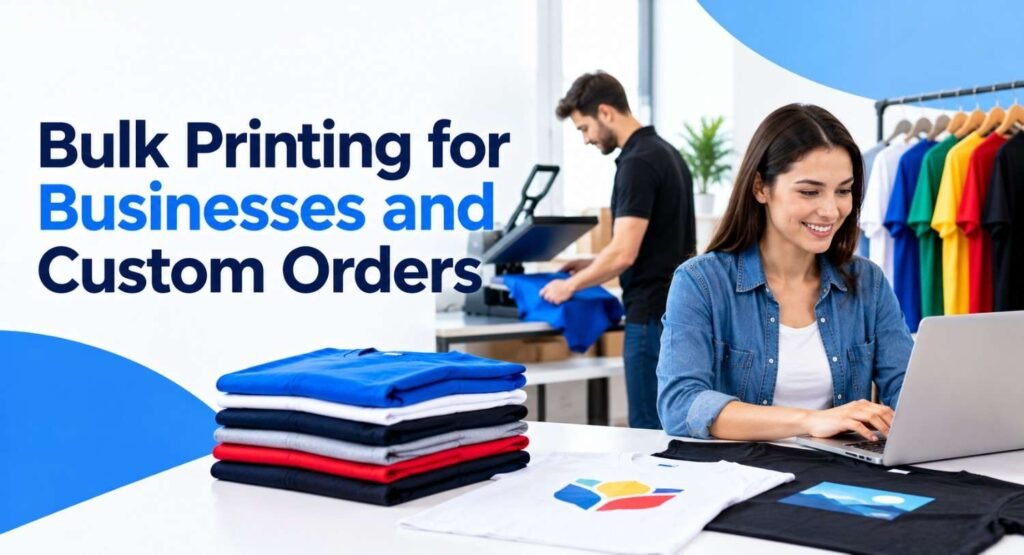
Ordering printed clothing in large quantities can be a practical way for businesses, organisations and groups to create a consistent and recognisable look. Whether you need staff uniforms, promotional merchandise, event clothing or branded garments, placing a larger order requires more planning than buying a few individual printed items.
Bulk Printing for Businesses can make it easier to manage large quantities, but choosing the right garments, artwork, printing method, sizes and quantities is essential. A well-planned order can help reduce avoidable problems and ensure that the finished garments are suitable for their intended purpose.
Why Do Businesses Choose Bulk T-Shirt Printing?
Businesses order printed T-shirts for many different reasons. Some need practical workwear, while others want branded clothing for marketing, events or customer engagement.
Common uses include:
- Staff uniforms and workwear
- Company events and conferences
- Promotional campaigns
- Product launches
- Trade shows and exhibitions
- Charity and fundraising events
- Sports teams and activity groups
- Hospitality and retail staff
- Branded merchandise
- Corporate gifts
A consistent design can help create a professional appearance when several employees or team members wear the same clothing. Printed T-shirts can also provide a visible way to display a company name, logo, slogan or campaign message.
For businesses ordering regularly, a consistent approach to garment style, branding and sizing can also make future orders easier to organise.
How Should You Plan a Large Custom Printing Order?
The first step is to establish exactly what the order needs to achieve. Avoid choosing garments or printing options before deciding how and where the finished items will be used.
Consider these points:
- Purpose: Decide whether the T-shirts are for uniforms, promotion, events, merchandise or another purpose.
- Quantity: Estimate the total number of garments required and allow for any additional pieces that may be useful.
- Design: Prepare the logo, artwork, text or other branding elements before requesting the final print.
- Garment type: Consider the style, colour, fabric and fit required for the intended users.
- Sizes: Create a realistic size breakdown rather than ordering equal numbers of every size.
- Deadline: Allow enough time for artwork preparation, production and delivery.
- Budget: Set a realistic budget that considers the garments, printing and any additional requirements.
Good preparation is particularly important for Bulk Printing for Businesses because an error affecting a large order can be more difficult to correct than an issue with a single garment.
What Should You Check Before Approving the Artwork?
Artwork should be checked carefully before production begins. A design that looks correct on a computer screen may not always produce the expected result when printed on fabric.
Check the following:
- Company name and spelling
- Logo proportions
- Text size and readability
- Image quality
- Design placement
- Print dimensions
- Colour requirements
- Front, back or sleeve placement
- Artwork suitability for the chosen garment colour
It is also useful to consider where the design will be positioned. A small chest logo may be appropriate for staff clothing, while a larger front or back design may be more suitable for promotional or event T-shirts.
How Many T-Shirts Should You Order?
The number of T-shirts you need will depend on the purpose of the order, the number of people receiving them and whether the garments are intended for regular use or a specific event. Start by creating a list of everyone who needs a T-shirt and consider whether each person requires one or more garments. For staff uniforms, you may need additional items so employees can have clean replacements between shifts. For events and promotional campaigns, estimate attendance carefully and consider how many garments are likely to be distributed. Ordering a small reserve can also be useful when there is a possibility of last-minute requirements, replacements or unexpected changes.
What Should You Consider When Choosing T-Shirt Sizes?
Choosing the correct size breakdown is important when placing a large T-shirt order because ordering equal quantities of every size may not reflect the actual requirements of your group. Where possible, collect size information from employees, team members or participants before confirming the order. For an existing company or organisation, previous uniform or clothing records can provide a useful indication of the sizes commonly required. It is also worth checking the specific size chart for the chosen garment, as sizing can vary between brands and styles. A clear size breakdown can help reduce the risk of having too many unwanted sizes while ensuring that everyone receives a comfortable fit.
How Can You Choose the Right Garments for a Business Order?
The best garment depends on how the clothing will be used. A T-shirt intended for occasional promotional use may have different requirements from one worn regularly as part of a work uniform.
For regular staff use, consider comfort, fit, fabric and durability. Employees may wear the garments for several hours at a time, so the material should be suitable for the working environment.
For promotional campaigns, appearance and branding may be the main priorities. If the T-shirts are being distributed to customers or used as merchandise, selecting a versatile style and a practical range of sizes can be useful.
Colour is another important consideration. A garment colour should complement the printed artwork while maintaining sufficient contrast for logos and text to remain clear.
Before placing a large order, it can be sensible to review the garment and print specifications carefully and, where available, consider a sample or proofing process.
What Printing Details Matter Most for Large Orders?
The printing method, artwork and garment all need to work together. Different designs can have different requirements depending on their size, detail, colour coverage and intended use.
When discussing Bulk Printing for Businesses, provide as much information as possible about the design and order. Useful details include:
- Number of garments
- Garment colours
- Garment styles
- Size breakdown
- Print locations
- Artwork format
- Approximate print dimensions
- Required delivery date
- Any specific branding requirements
A simple one-colour logo may have different production considerations from a detailed full-colour graphic. Similarly, printing on the front of a T-shirt differs from producing artwork on multiple locations.
Clear specifications help reduce misunderstandings and make it easier to assess whether the final order meets the original requirements.
When Should You Place a Bulk T-Shirt Order?
Timing depends on the size and complexity of the order, as well as the required delivery date. It is generally better to start planning before the clothing is urgently needed.
For an upcoming event, campaign or business launch, allow time for:
- Finalising the artwork
- Confirming garment choices
- Checking sizes
- Reviewing production details
- Resolving any artwork issues
- Printing the order
- Delivery or collection
- Checking the finished garments
Last-minute orders can leave less room to correct mistakes. If the clothing is needed for a specific event, building some extra time into the schedule can provide a useful buffer.
Businesses that order regularly can also benefit from keeping records of previous garment styles, sizes, colours and artwork. This can make repeat Bulk Printing for Businesses orders more straightforward.
How Much Does Bulk Printing for Businesses Cost?
There is no single price for a large custom printing order because the total cost depends on several factors.
The main considerations can include:
- Number of T-shirts ordered
- Type and quality of garments
- Number of print locations
- Size of the printed design
- Artwork complexity
- Printing requirements
- Garment colours
- Size range
- Production requirements
- Delivery arrangements
Larger quantities may affect the price per garment, but businesses should not make decisions based solely on the lowest available price.
A cheaper garment may not provide the appearance, comfort or suitability required for regular staff use. Similarly, choosing a printing option based only on price may not be appropriate for a detailed or highly visible design.
The most useful approach is to compare the complete order requirements and understand exactly what is included before approving production.
Can Businesses Use Bulk Printing for Custom Orders?
Yes. Custom orders can be adapted for different business requirements, provided the artwork and garment specifications are clearly defined.
For example, a company may require the same logo across all T-shirts but different sizes for employees. Another business may need separate designs for different departments, events or campaigns.
Customisation can include elements such as:
- Company logos
- Brand names
- Slogans
- Campaign graphics
- Event names
- Team names
- Staff-related designs
- Promotional messages
When several versions are required, organise the order carefully. Create a clear list showing each design, garment colour, quantity and size breakdown. This can help prevent one design or size combination from being confused with another.
For companies using Bulk Printing for Businesses as part of an ongoing branding strategy, keeping the artwork consistent can also help maintain a recognisable visual identity across different orders.
What Mistakes Should Businesses Avoid?
Large custom orders can become complicated when basic details are overlooked. Several common mistakes are avoidable with careful preparation.
Ordering the wrong quantity:
Review expected usage before confirming the final number. Consider whether additional garments are needed for new staff, replacements or event requirements.
Ignoring the size breakdown:
A total quantity alone is not enough. Make sure the order includes a practical distribution of sizes.
Using unsuitable artwork:
Low-quality or incorrectly prepared artwork can affect the appearance of the final print.
Forgetting print placement:
Specify whether the design belongs on the front, back, sleeve or another location.
Leaving ordering too late:
A tight deadline can reduce flexibility if changes are required.
Not checking the final details:
Before production, review the design, quantities, colours, sizes and other specifications carefully.
How Can You Make Repeat Business Printing Orders Easier?
Once a company has completed its first order, future orders can often be organised more efficiently by keeping accurate records.
Save the final artwork files and document the garment details, colours, print locations and size distribution. If the same design is required again, having these details available can reduce the time needed for preparation.
It can also be useful to monitor which sizes are used most frequently. Over several orders, this information may help create a more accurate size breakdown.
For businesses with seasonal campaigns or recurring events, planning orders in advance can make the process more predictable.
A structured approach to Bulk Printing for Businesses can therefore help with both one-off projects and ongoing branded clothing requirements.
Frequently Asked Questions
What is the best quantity for a business T-shirt order?
The appropriate quantity depends on the purpose of the clothing. Consider the number of employees, event attendees, promotional recipients or customers expected to receive the T-shirts before deciding on the final quantity.
Can I order different sizes in the same bulk order?
Yes, a business order can generally include a range of sizes. Prepare a clear size breakdown so the total quantity and individual sizes are easy to confirm.
Can a business print its logo on T-shirts?
Yes. Company logos are commonly used for staff clothing, promotional garments, events and branded merchandise. The artwork should be prepared clearly and checked for suitable print quality and dimensions.
Should I order extra T-shirts for a business event?
Ordering a small number of additional garments can be useful when attendance numbers may change or replacement items may be needed. The appropriate quantity depends on the event and budget.
Can different designs be included in one custom order?
This depends on the production requirements, but businesses can have different designs for separate groups, campaigns or purposes. Each design should be clearly identified with its corresponding quantities and garment specifications.
What information should I provide when requesting a bulk printing quote?
Provide the approximate quantity, garment type and colour, size breakdown, artwork, print locations and required date. Detailed information helps establish the requirements of the order more clearly.
Is bulk printing suitable for staff uniforms?
Yes. Printed T-shirts can be used as part of staff clothing where the garment style, comfort, branding and intended working conditions are appropriate.
How can I prepare for a large custom T-shirt order?
Start by confirming the purpose, quantity, artwork, garment specifications, sizes and deadline. Review all details before production and keep the final specifications for future orders.
For businesses looking to organise a large custom clothing project, T-Shirt Print London provides a dedicated option for planning printed T-shirts around business, promotional and custom requirements.