DTF T-Shirt Printing is a modern garment printing method that allows detailed, colourful designs to be transferred onto fabric using a special film and heat. Unlike traditional screen printing, it does not require separate screens for each design, making it suitable for everything from one-off personalised shirts to small and medium-sized orders.
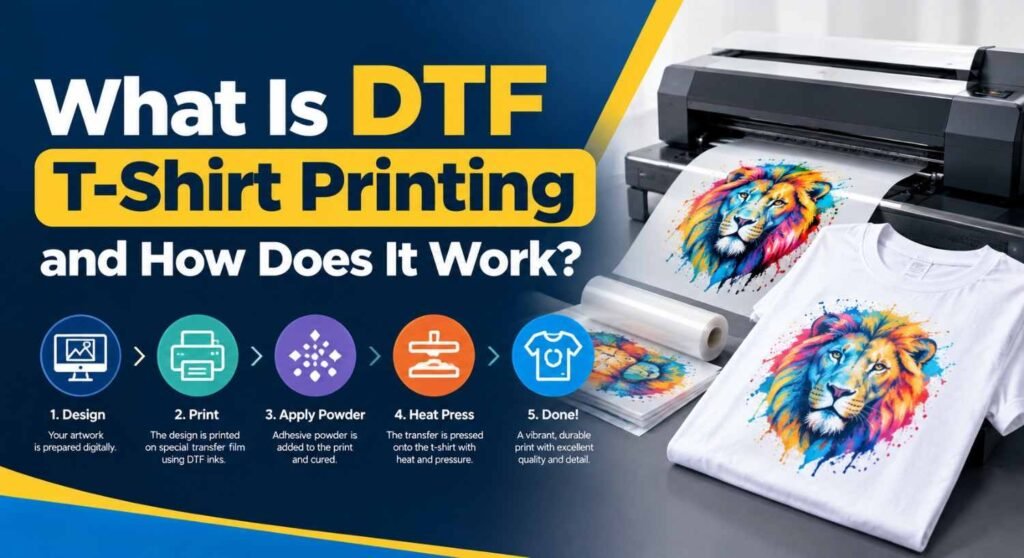
The process involves printing a design onto a coated transfer film, applying a special adhesive powder, curing the transfer and then pressing it onto a T-shirt with controlled heat and pressure. The result is a vibrant print that can reproduce detailed artwork, text, photographs and multi-colour graphics.
But how does the process actually work, and when is it the right choice for your T-shirt project?
How Does DTF T-Shirt Printing Work?
The DTF process involves several carefully controlled stages. Each stage contributes to the final quality, durability and appearance of the printed garment.
How Is the Design Printed onto the Film?
First, the artwork is prepared digitally and printed onto a special PET transfer film using a compatible DTF printer. The printer uses specialised textile inks to reproduce the colours and details of the design.
A white ink layer is also used as part of the process. This is particularly important when printing colourful artwork because it helps the design remain visible when transferred onto different fabric colours.
The artwork is normally printed in a mirrored format so that it appears correctly when transferred onto the T-shirt.
How Is the Adhesive Powder Applied?
After the design has been printed, a fine hot-melt adhesive powder is applied to the wet ink on the film.
The powder sticks to the printed areas and provides the bonding layer that will eventually attach the design to the fabric. Excess powder is removed so that adhesive does not remain where it is not needed.
How Is the Transfer Cured?
The adhesive powder must then be cured using controlled heat. This melts the powder and turns it into an even adhesive layer.
Proper curing is important because insufficient or uneven heating can affect how well the transfer bonds to the garment.
How Is the Design Transferred to the T-Shirt?
Once the transfer is ready, it is positioned on the garment. A heat press applies a specific combination of temperature, pressure and pressing time.
The heat activates the adhesive, allowing the printed design to bond with the fabric. After pressing, the transfer film is removed according to the film manufacturer’s recommended process, leaving the design on the T-shirt.
This final stage needs to be handled carefully to achieve a clean and consistent result.
Why Is DTF T-Shirt Printing So Popular?
One of the main reasons for the growing popularity of DTF T-Shirt Printing is its flexibility. The technique can reproduce complex artwork without requiring the same setup associated with traditional screen printing.
It can be particularly useful for designs containing:
- Multiple colours
- Fine details
- Small text
- Gradients
- Illustrations
- Photographic elements
- Logos and branding
- Intricate patterns
Another advantage is that the design is prepared digitally, which makes it easier to produce different artwork without creating a separate screen for every design.
What Types of T-Shirts Can Be Printed with DTF?
DTF transfers can be applied to a wide range of garments and fabric types, although the exact result depends on the material, transfer quality and heat-press settings.
The method is commonly considered for:
- Cotton T-shirts
- Polyester garments
- Cotton-polyester blends
- Hoodies
- Sweatshirts
- Workwear
- Promotional clothing
- Personalised garments
It can also be useful when a project involves different garment colours or materials. However, every fabric reacts differently to heat, so appropriate temperature and pressing settings are important.
Can DTF Printing Be Used on Dark T-Shirts?
Yes, DTF can be used on both light and dark garments.
The white ink layer helps create an opaque base beneath the colours of the design. This allows bright artwork to remain visible instead of being significantly affected by the colour of the fabric underneath.
For example, a colourful design printed directly onto a dark T-shirt without an appropriate white base could lose some of its visual impact. The white layer in a DTF transfer helps prevent this issue.
What Are the Main Benefits of DTF Printing?
DTF T-Shirt Printing offers several practical benefits for personalised clothing and commercial garment projects.
Why Is It Good for Detailed Designs?
Because the artwork is printed digitally, DTF can reproduce fine details and complex colour combinations. This makes it suitable for artwork that would be more difficult or time-consuming to reproduce using some traditional printing methods.
Why Is It Useful for Small Orders?
DTF does not require the same screen preparation used for traditional screen printing. This can make it practical for smaller quantities, samples and personalised garments.
It can also allow different designs to be produced within the same overall project rather than requiring one large run of identical artwork.
Can DTF Produce Bright Colours?
DTF can produce vibrant and detailed graphics when suitable inks, films, powder and pressing conditions are used.
The white ink layer also helps colours stand out on darker garments.
Is DTF Suitable for Personalised T-Shirts?
Yes. The digital nature of the process makes it suitable for customised clothing where individual names, graphics, numbers or other design elements may need to be changed between garments.
This can be useful for events, clubs, businesses, gifts and personalised clothing.
How Does DTF Compare with Screen Printing?
DTF and screen printing use different production methods, so the most suitable option depends on the design, fabric, quantity and desired result.
Screen printing uses physical screens to apply ink to the garment, with different screens generally required for different colours. It can be highly effective for larger quantities of designs that do not require frequent changes.
DTF, on the other hand, uses a digitally printed transfer. This makes it particularly flexible for detailed artwork, multiple colours and smaller or personalised orders.
For a simple design being produced in a large quantity, screen printing may be worth considering. For complex artwork or smaller quantities, a transfer-based process can offer greater flexibility.
How Long Does a DTF Print Last?
The lifespan of a DTF print depends on several factors, including the quality of the transfer, garment material, curing and heat-press process, washing conditions and general garment care.
A properly produced transfer should remain attached to the fabric through normal use and washing when the garment is cared for according to recommended instructions.
To help protect the print, it is generally advisable to follow the garment supplier’s care instructions, avoid unnecessarily high washing temperatures and use appropriate washing and drying methods.
The quality of the original transfer and application process is just as important as how the garment is cared for afterwards.
What Should You Consider Before Ordering DTF Prints?
Before placing an order, consider the artwork, garment and intended use.
Is the Artwork Suitable?
High-quality artwork generally produces better results. Vector artwork is useful for logos and graphics, while high-resolution raster images may be appropriate for detailed illustrations or photographs.
Very small text and extremely fine details should be checked before printing because they may not reproduce as clearly as larger elements.
What Fabric Will Be Used?
Tell the printer what type of garment you want to use. Different materials can require different heat-press settings, and some fabrics may be more sensitive to heat than others.
How Many T-Shirts Do You Need?
The quantity can influence which printing method makes the most practical sense. DTF can be useful for smaller runs and personalised orders, while other methods may become more suitable for certain high-volume projects.
What Size Should the Design Be?
The intended print position and dimensions should be decided before production. Common locations include the front, back and chest area, but the ideal size depends on the garment and artwork.
Is DTF T-Shirt Printing Suitable for Businesses?
DTF can be useful for businesses that need branded clothing, promotional T-shirts, uniforms or small batches of customised garments.
It is particularly flexible when a business wants to use detailed logos or artwork across different garment colours. It can also be practical when designs change regularly or when relatively small quantities are required.
For businesses ordering printed clothing, it is worth considering the design complexity, number of garments, garment type, budget and expected frequency of future orders before choosing a printing technique.
How Should You Wash a DTF-Printed T-Shirt?
Proper garment care can help maintain the appearance of the print.
Follow the manufacturer’s washing instructions, but common care recommendations include:
- Turn the T-shirt inside out before washing.
- Avoid unnecessarily high washing temperatures.
- Use a suitable washing cycle for the garment.
- Avoid harsh treatment of the printed area.
- Follow the recommended drying instructions.
- Do not apply direct, excessive heat to the printed design.
The exact care instructions can vary depending on the garment and transfer system, so the supplier’s instructions should take priority.
How Much Does DTF T-Shirt Printing Cost?
The cost can vary considerably depending on the garment, print size, number of printed areas, quantity, artwork requirements and supplier.
A single personalised T-shirt may have a different price structure from a larger order containing the same design. Additional printing positions, specialist garments or complex requirements can also affect the final cost.
For an accurate price, provide the printer with the number of T-shirts, garment type, colours, design dimensions, print locations and artwork details.
When Should You Choose DTF Printing?
DTF is worth considering when you need detailed, colourful artwork, personalised garments or a relatively small batch of T-shirts.
It can be a practical option for:
- Personalised T-shirts
- Business branding
- Event clothing
- Club and team apparel
- Promotional garments
- Small clothing collections
- Detailed logos and illustrations
- Designs containing multiple colours
For projects requiring large quantities of a relatively simple design, it can still be useful to compare DTF with other printing techniques before making a decision.
Where Can You Get DTF T-Shirt Printing?
Choosing a reliable printing provider is important because the quality of the film, inks, adhesive powder, curing process and heat pressing can all influence the finished garment.
If you are looking for professional DTF T-Shirt Printing in London, T-Shirt Print London provides printed T-shirt solutions for different custom clothing requirements.
Before ordering, check that the provider understands your artwork, garment requirements, quantity and desired print placement. Providing clear artwork and accurate specifications can also help avoid production issues.
Frequently Asked Questions
Can DTF Printing Be Used for One T-Shirt?
Yes. DTF is suitable for individual personalised garments as well as larger quantities. The digital transfer process means you do not necessarily need a large production run to create a custom design.
Does DTF Printing Work on Cotton?
Yes, DTF transfers can be applied to cotton garments. They can also be used on several other commonly printed fabrics, although the appropriate application settings depend on the specific garment and transfer system.
Can DTF Prints Include Photographs?
Yes. Digital printing allows DTF transfers to reproduce detailed images, including photographs, provided the source artwork has sufficient resolution and the transfer is produced correctly.
Is DTF Better Than Screen Printing?
Neither method is universally better. DTF and screen printing have different strengths. DTF can offer flexibility for detailed designs, multiple colours and smaller personalised orders, while screen printing can be well suited to certain larger-volume projects.
Can You Print White Designs with DTF?
Yes. White ink is an important part of the DTF process and allows white artwork and an opaque base layer to be produced on garments, including dark-coloured T-shirts.
Can DTF Transfers Peel Off?
A properly produced and applied transfer should bond securely to the garment. Peeling or lifting can occur when the transfer is poor quality, incorrectly cured or pressed, or when unsuitable washing and care methods are used.
Does DTF Printing Feel Thick on a T-Shirt?
The finished print can have a noticeable feel because the design sits as a transferred layer on the fabric. The exact feel depends on the artwork size, ink coverage, transfer materials and production process.
Is DTF Suitable for Business Logos?
Yes. DTF can be suitable for business logos, particularly when the logo contains multiple colours, gradients or fine details. The artwork should be prepared at an appropriate quality and checked for the intended print size before production.