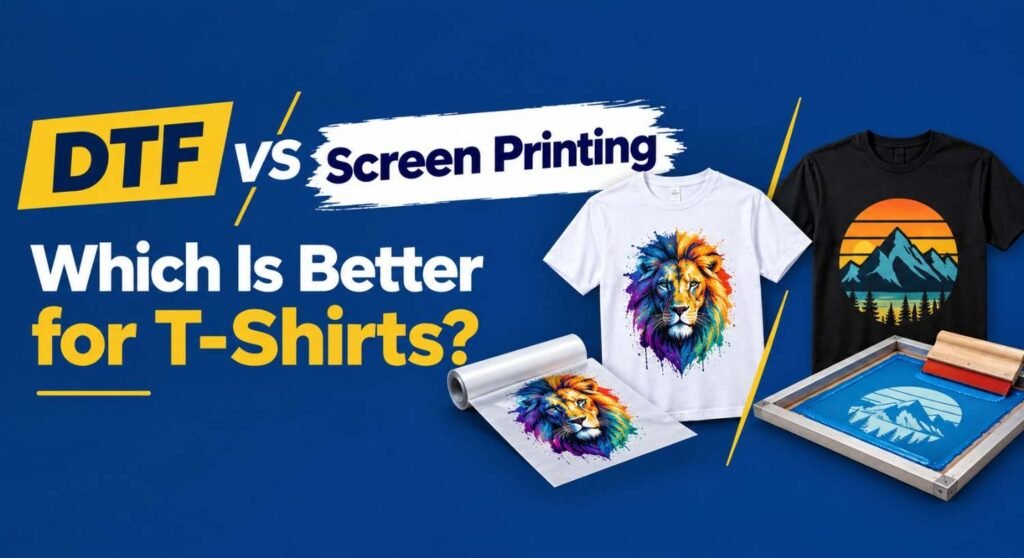
Choosing the right printing method can make a big difference to the appearance, durability and cost of custom T-shirts. Two of the most popular options are direct-to-film (DTF) printing and screen printing. Both can produce high-quality results, but they work differently and are better suited to different types of designs and orders.
Understanding the difference between DTF vs Screen Printing can help you choose the right method based on your artwork, order quantity, fabric, budget and desired finish.
What Is DTF Printing?
DTF, or direct-to-film printing, is a digital printing process where artwork is printed onto a special transfer film before being transferred onto a T-shirt using heat and pressure.
Unlike traditional screen printing, DTF does not require a separate screen for each colour. This makes it particularly useful for detailed artwork, photographs, gradients and designs containing several colours.
The process generally involves:
- Preparing the artwork digitally.
- Printing the design onto DTF transfer film.
- Applying a layer of adhesive powder.
- Curing the transfer.
- Applying it to the garment with a heat press.
DTF can be used on a range of fabric types and colours, making it a flexible option for custom clothing.
What Is Screen Printing?
Screen printing is a traditional garment printing technique that pushes ink through a mesh screen onto the fabric. A separate screen is normally prepared for each colour used in the design.
The ink is applied directly to the garment and then cured so that it bonds with the fabric.
Screen printing is well established in the custom clothing industry and is especially popular for larger orders where the same design needs to be reproduced across many garments.
The method can create strong, vibrant prints with a distinctive feel, particularly when suitable inks and garments are used.
How Does DTF Compare With Screen Printing?
The main difference between DTF and screen printing is how the design is transferred to the garment.
DTF uses a digitally printed transfer, while screen printing applies ink directly through a prepared mesh screen. This difference affects setup time, design flexibility, production efficiency and the economics of different order sizes.
Here are some of the main factors to consider:
| Factor | DTF Printing | Screen Printing |
| Design detail | Excellent | Good, depending on artwork |
| Multiple colours | Easy to produce | Requires additional screens |
| Gradients and photographs | Very suitable | More difficult |
| Small orders | Usually suitable | Less economical |
| Large orders | Suitable | Often highly efficient |
| Setup | Relatively simple | More preparation required |
| Print feel | Can have a noticeable transfer layer | Can feel integrated with the fabric depending on ink |
| Personalisation | Excellent | Less convenient |
| Colour matching | Digital colour process | Strong control with suitable inks |
The best choice depends on what you are printing rather than one method being universally better.
Why Is DTF Better for Detailed Designs?
DTF is particularly useful when a T-shirt design contains fine details, multiple colours, photographic elements or colour gradients.
Because the artwork is produced digitally, complicated designs can be prepared without creating a separate physical screen for every colour.
This makes DTF useful for designs such as:
- Detailed illustrations
- Photographs
- Full-colour logos
- Colour gradients
- Small text and intricate graphics
- Designs with many colours
For businesses creating customised garments, this flexibility can make digital transfer printing practical for a wide variety of designs.
Why Is Screen Printing Popular for Large Orders?
Screen printing can become increasingly efficient when the same artwork is being printed across a large number of garments.
Although creating the screens requires preparation, that initial setup can be spread across many T-shirts. Once the screens are ready, the same design can be reproduced efficiently.
This makes screen printing a common choice for:
- Company uniforms
- Event T-shirts
- Sports teams
- Promotional clothing
- School clothing
- Merchandise
- Large clothing orders
For simple designs with only a few colours, screen printing can also provide a bold and distinctive result.
Which Method Is More Durable?
Both DTF and screen printing can produce durable T-shirt prints when the correct materials, equipment and curing processes are used.
However, durability is not determined by the printing method alone. The quality of the garment, ink or transfer materials, application process and washing habits can all affect how long a print lasts.
To help preserve printed clothing, it is generally sensible to:
- Follow the manufacturer’s washing instructions.
- Avoid unnecessarily high washing temperatures.
- Turn printed garments inside out before washing.
- Avoid harsh chemicals where possible.
- Allow garments to dry according to the care instructions.
A properly produced print should withstand normal use, but no printed garment is completely unaffected by repeated washing and wear.
When Should You Choose DTF Printing?
DTF can be a practical choice when you need flexibility, detailed artwork or a relatively small number of garments.
It is particularly worth considering when:
- Your design contains several colours.
- You want photographic or highly detailed artwork.
- You need personalised T-shirts.
- You are ordering a small quantity.
- You need different designs across individual garments.
- You want to avoid extensive screen setup.
- Your artwork contains gradients or complex colour combinations.
For one-off garments and short runs, the ability to produce different designs without preparing multiple screens can be a significant advantage.
When Should You Choose Screen Printing?
Screen printing may be more appropriate when you are producing a larger quantity of garments featuring the same relatively simple design.
It can work particularly well when:
- You are ordering a large batch.
- The design uses a limited number of colours.
- You want bold, solid areas of colour.
- The same artwork will be printed repeatedly.
- You are producing uniforms or promotional clothing.
- You want a traditional screen-printed finish.
The economics of screen printing generally become more attractive when setup costs can be distributed across a larger order.
How Much Does DTF Printing Cost Compared With Screen Printing?
There is no single price difference that applies to every order because the cost depends on several variables.
These can include:
- Number of T-shirts
- Garment type and quality
- Print size
- Number of print locations
- Artwork complexity
- Number of colours
- Production requirements
- Personalisation
- Finishing requirements
For smaller quantities and complex designs, DTF can be a convenient option because there is less physical setup involved.
For larger quantities of the same simple design, screen printing may become more cost-effective because the setup is spread across more garments.
Rather than comparing the printing price alone, consider the total cost of producing the complete order.
Can DTF Be Used on Different T-Shirt Fabrics?
Yes. One of the useful characteristics of DTF printing is its compatibility with a variety of garment materials.
Depending on the specific transfer system and garment, DTF can be used on materials including cotton, polyester and blends.
However, not every garment will behave in exactly the same way during heat application. Fabric composition, colour, surface texture and heat tolerance should be considered before production.
If you are unsure which garment is suitable, checking the manufacturer’s application requirements is important.
Can Screen Printing Produce More Vibrant Colours?
Screen printing can produce strong, opaque colours, particularly when appropriate inks and printing techniques are used.
It is often well suited to bold artwork where large areas of solid colour are required. The final appearance can also vary depending on the garment colour, ink type and number of layers applied.
DTF can also produce highly detailed and colourful designs, but the visual result is different because the artwork is transferred from film rather than being printed directly through a screen.
For this reason, the choice should be based on the appearance you want rather than assuming one process always produces better colours.
Is DTF or Screen Printing Better for Personalised T-Shirts?
DTF is generally more convenient when every T-shirt needs a different name, number, image or design.
Because the artwork can be changed digitally, personalised garments can be produced without preparing a new physical screen for every variation.
Screen printing can still be used for personalised clothing, but producing many different designs or individual variations can require additional setup and production work.
This makes DTF particularly useful for small personalised orders, gifts, clubs and garments where each item needs unique artwork.
Which Printing Method Should Businesses Use?
Businesses should choose their printing method according to the type of clothing they need rather than choosing based on the printing technology alone.
For example, a company ordering hundreds of identical T-shirts with a simple logo may consider screen printing. A business producing a smaller batch of colourful promotional garments may prefer DTF because of its design flexibility.
The garment itself also matters. Think about the fabric, colour, intended use, number of garments and artwork before deciding.
For businesses in London looking for custom T-shirt printing, T Shirt Print London provides an option for producing personalised printed garments based on different design and order requirements.
What Should You Consider Before Choosing a Printing Method?
Before placing an order, consider these five questions:
- How many T-shirts do you need?
The quantity can affect which process makes the most financial sense. - How complex is your design?
Detailed, photographic and multi-colour artwork may favour DTF. - How many colours does the design contain?
Simple designs can work particularly well with screen printing. - Does every T-shirt need to be different?
DTF is convenient when individual personalisation is required. - What finish do you want?
Different printing processes create different visual and tactile results.
So, Which Is Better for T-Shirts?
The choice between DTF vs Screen Printing ultimately depends on the requirements of your T-shirt order.
DTF is particularly useful for detailed, colourful and personalised designs, especially when ordering smaller quantities or several different designs. Screen printing can be highly suitable for larger batches of the same design, particularly when the artwork is relatively simple and uses solid colours.
Neither method is automatically the right choice for every T-shirt project. The best option depends on your design, quantity, garment, budget and desired finish.
For custom clothing, choosing the printing process based on these practical factors can help you achieve a better balance between appearance, durability, flexibility and overall cost.
Frequently Asked Questions
Is DTF better than screen printing for small orders?
DTF can be more convenient for small orders because it does not require the same type of screen preparation for each colour. This makes it well suited to short runs, one-off garments and personalised designs.
Does DTF printing last as long as screen printing?
Both can be durable when produced correctly. The lifespan of a print depends on factors such as material quality, application or curing, garment fabric and washing practices.
Is DTF cheaper than screen printing?
It depends on the order. DTF can be economical for smaller or highly customised orders, while screen printing can become more cost-effective for larger quantities of the same design.
Can DTF print photographs on T-shirts?
Yes. DTF is well suited to detailed full-colour artwork, including photographs, illustrations, gradients and designs containing many colours.
Is screen printing suitable for detailed artwork?
Screen printing can reproduce detailed artwork, but very complex images, gradients and photographic designs can require additional techniques and preparation. DTF is often more straightforward for this type of artwork.
Which printing method is best for personalised T-shirts?
DTF is generally convenient for personalised T-shirts because digital artwork can be changed from one garment to another without creating a separate screen for every variation.
Can DTF and screen printing be used on dark T-shirts?
Yes. Both methods can be used on dark garments, although the printing process and materials required can differ. The garment colour should be considered when preparing the artwork and selecting the appropriate printing method.
What is the main difference between DTF and screen printing?
The main difference is the application process. DTF prints artwork onto a special film and transfers it to the garment using heat, while screen printing pushes ink through a prepared mesh screen directly onto the fabric.